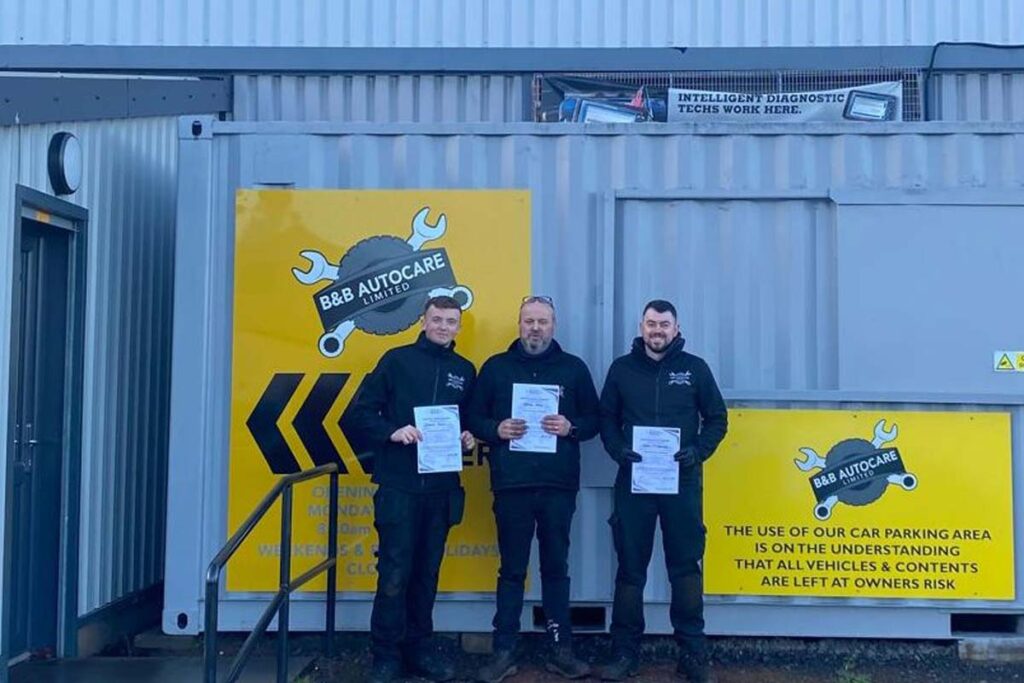
EEC’s Technical Trainer, Stuart Still, recently delivered an in-depth two-day training program for the team at B & B Autocare in South Lanarkshire. The bespoke sessions focused on key areas of emissions control, diagnostics, and best-practice fitting procedures, helping technicians build confidence and enhance their technical knowledge. Stuart explains below why high-quality, professional automotive training is more important than ever in today’s fast-changing industry.
When visiting customers, I always make time to discuss training opportunities—whether for distributors, factors, or their customers. I’m especially passionate about arranging sessions for local colleges, ensuring tutors remain up to date with the latest emissions control technologies.
Getting the Most from Diagnostic Tools
One of the most common diagnostic tools in the repair sector is the four-gas analyser. While essential for MOT testing, it is rarely used to its full diagnostic potential. I’m often surprised by how little information is extracted after completing an emissions test. Typically, the customer is simply told, “Your car has passed (or failed) the MOT on emissions.” However, the MOT only reports on three values—CO, HC, and lambda. For example, if a vehicle records CO 0.35, HC 123 ppm, and lambda 0.99 at 2500 rpm, it would fail the MOT.
Many would immediately conclude that the catalytic converter needs replacing because the CO level is too high.
Fitting a new catalytic converter might reduce the CO to 0.2, allowing the vehicle to pass. But this is often only a temporary fix. The CO and HC levels will likely rise again soon if the underlying problem isn’t addressed—risking damage to the new catalytic converter.
Reading the Full Picture
To properly diagnose the fault, technicians must look beyond the MOT’s limited data. A full emissions report from the four-gas analyser should include CO, CO₂, HC, O₂, and lambda. The missing gases—CO₂ and O₂—are critical to identifying the real cause of emissions issues.
Let’s take the earlier example and add CO₂ and O₂ values:
– CO 0.35, HC 123 ppm, CO₂ 13.6, O₂ 0.56, lambda 0.99
Here, the O₂ value is too high (it should be below 0.2). This suggests a small air leak—perhaps from a damaged gasket, failed seal, or tiny hole between the exhaust manifold and the first lambda sensor.
This leak allows excess air into the exhaust before the lambda sensor, tricking the ECU into thinking the engine is running lean. The ECU compensates by enriching the mixture to maintain the 14.7:1 air–fuel ratio (lambda 1.0). The result is an overly rich mixture, higher HC emissions, and ultimately, damage to the catalytic converter—potentially even within its warranty period.
The solution is simple: locate and repair the air leak using a diagnostic smoke unit, which can reveal leaks anywhere in the system.
Best Practice for Technicians
We recommend printing and analysing a full four-gas report during every MOT emissions test—and again after fitting a new catalytic converter. This is an excellent opportunity to identify underlying issues such as over-fuelling, air filter restriction, exhaust leaks, ignition faults, or catalytic converter inefficiency.
If you know the catalytic converter is functioning at 100%, then any irregularities must originate elsewhere.
Ideal four-gas values at 2500 rpm:
– CO: < 0.2%
– CO₂: > 13.5%
– O₂: < 0.2%
– HC: < 15 ppm
– Lambda: 0.99–1.01
EEC’s Commitment to Training
At EEC, we’ve launched a comprehensive Emissions Training Programme covering catalytic converters, lambda sensors, exhaust systems, and how to interpret four-gas analyser data effectively. Training sessions can be arranged during the day or evening to suit your schedule. For more information or to arrange training, please contact: Ben Kendrick or Stuart Still
By Stuart Still, European Exhaust and Catalyst (EEC)