Independent garages and bodyshops may need to re-evaluate some of the most fundamental pieces of equipment in their workshops, as increasing vehicle size and weight begin to outpace ageing four-post lifts.
That is the message from A1 ADAS Group, which reports a marked rise in enquiries for replacement lifts and updated wheel alignment systems over the past year. According to the company, many ramps installed in the 1980s and 1990s remain operational but are no longer ideally suited to the dimensions and mass of modern vehicles, particularly EVs. Matt Hume, UK national sales manager at A1 ADAS Group, believes the issue is less about wear and tear and more about the changing vehicle parc.
“Ramps were built to last and many older lifts are still mechanically sound,” he said. “But vehicles are wider, wheelbases are longer and electrification has added significant weight. We’re seeing more workshops realise that older lifts are starting to limit what they can safely and efficiently take on. That’s when they call us.”
A decade ago, a typical family hatchback weighed around 1.3 to 1.4 tonnes. Today’s electric equivalent can be several hundred kilograms heavier due to battery systems and reinforced structures. Combined with wider tracks and longer platforms, that shift is testing the design limits of older lifting equipment.
“One of the biggest risks is that workshops don’t always appreciate how close to the threshold some equipment is operating,” Hume added. “If a lift can technically raise a vehicle, that doesn’t necessarily mean it’s doing so with the safety margin you would want.” Kent-based Coachwork Renovations recently faced that reality. While its existing lift was still functioning, it was too narrow and too short to comfortably accommodate many modern vehicles, particularly vans. As a result, certain jobs had to be declined.
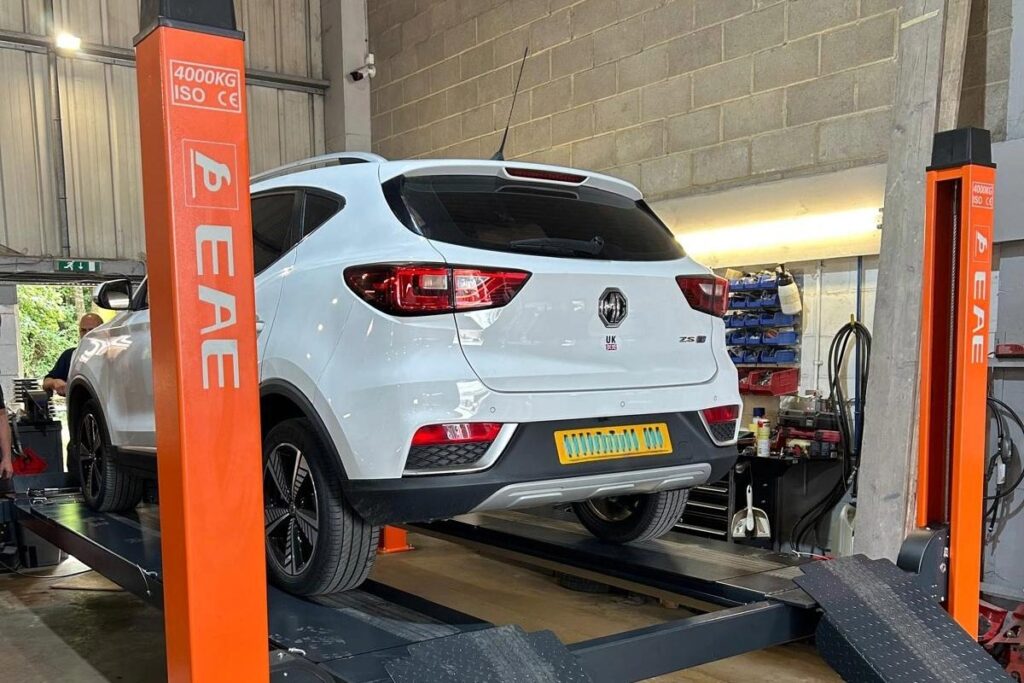
Working closely with A1, the bodyshop chose an EAE 6435B four-post alignment lift, specified to handle wider vehicles, longer wheelbases and higher weights, alongside a CJ 3.0-tonne rolling jacking beam to enable wheel-free lifting for alignment and suspension work.
Managing director Ben Smith said the upgrade has changed the scope of work the business can accept, opening up opportunities it previously had to turn away.
“Our old lift had been reliable for years, but it was narrow and the platforms were short,” Smith explained. “Modern cars were a squeeze, and vans were out of the question. Add EV weight into the mix, and it became clear it just wasn’t fit for purpose.
“We’re now able to take on longer vehicles, including vans, and expand the work we accept from insurers,” Smith added. “It’s improved efficiency and profitability.”
A site visit by A1 ensured the new lift would meet both vehicle requirements and the physical constraints of the premises, including access to an adjoining workshop. The old lift was removed the afternoon before installation, with the replacement operational by lunchtime the following day.
Hume says A1 is having similar conversations with bodyshops and garages across the UK. “Workshops are rightly investing in ADAS and diagnostics, but the lift is the foundation everything else sits on,” he said. “If that foundation isn’t suited to modern vehicles, it can restrict workflow, limit the work you can take on, and introduce unnecessary risk.”
With EV volumes continuing to rise and vehicle dimensions unlikely to shrink, reviewing lift capacity and platform size may become an increasingly important part of workshop planning.
Hume concluded: “The question isn’t simply whether your lift still works. It’s whether it’s still right for the vehicles coming through your doors.”